
Cloud vs. On-Premise Security: Which Is Right for Your Business?
When it comes to physical security, one of the most common decisions businesses face today is not just what cameras to buy or which access control system to install. It is where all of that data lives. Specifically, the question of whether to store your security footage and manage your systems on-premise or move everything to the cloud is one that more and more business owners and IT managers are wrestling with.
Both approaches have real merit. And the right answer depends on your business size, your infrastructure, your budget, and how you want to operate day to day. This post breaks down both options honestly so you can make an informed decision and know what to ask when you are ready to talk to a provider.
What Does On-Premise Security Actually Mean?
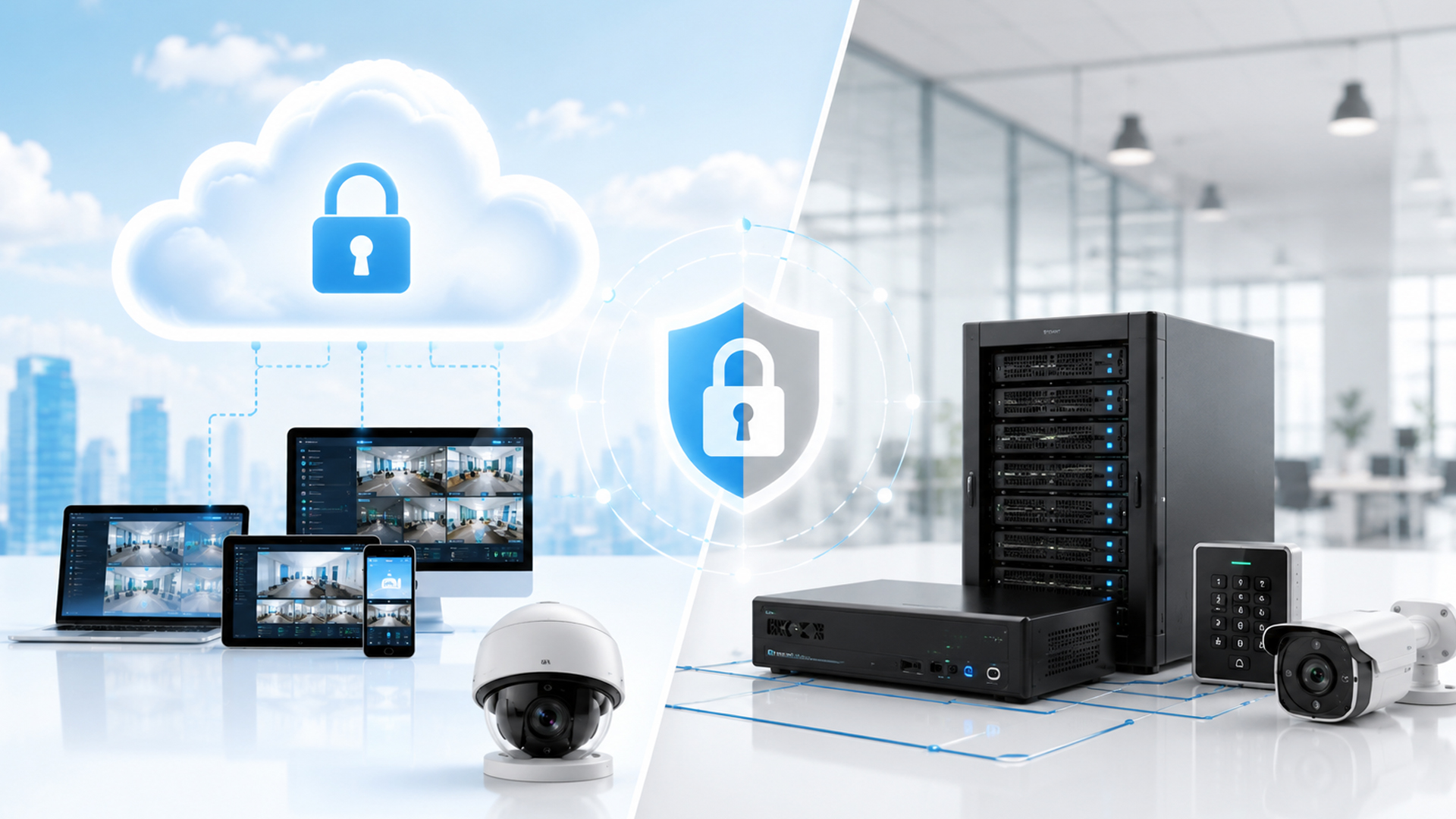
On-premise security means that your video footage, access control data, and system management all live on hardware that is physically located at your facility. This typically includes a dedicated video server or network video recorder (NVR), local storage in the form of hard drives, and software that runs on that local hardware.
Your security team or IT staff manages everything from within your network. Footage stays on-site. Access is controlled through your own infrastructure. And when something needs to be reviewed, someone typically needs to be at the location or connected to your internal network to pull it up.
For a long time, this was simply how physical security worked. And for certain businesses, it still makes a lot of sense.
What Does Cloud-Based Security Mean?
Cloud-based security means that your footage and system data are transmitted to and stored on remote servers managed by a cloud provider. Instead of a room full of servers and hard drives, your cameras and access control hardware connect to the internet and send their data offsite, where it is stored, managed, and accessible through a web browser or mobile app.
Some cloud systems are fully cloud-native, meaning the cameras themselves are designed to work only with a cloud platform. Others are hybrid, meaning your existing cameras can be connected to a cloud bridge that routes footage to the cloud without replacing the cameras themselves.
The management interface, the footage storage, the alerts, and the reporting all happen in the cloud. You can log in from anywhere and see what is happening at your facility in real time.
The Case for On-Premise Security
There are legitimate reasons why some businesses prefer to keep their security infrastructure on-site, and those reasons should be taken seriously rather than dismissed.
The first is control. With on-premise systems, your data never leaves your building. For businesses in highly regulated industries, government contractors, legal or financial firms, or organizations with strict data sovereignty requirements, keeping footage and access logs on internal hardware can be a compliance necessity rather than a preference.
The second is connectivity independence. On-premise systems do not rely on an internet connection to function. If your internet goes down, your cameras keep recording, your access control keeps working, and your security team can still review footage. For facilities in areas with unreliable connectivity, or for operations where internet downtime is simply not acceptable, this is a meaningful advantage.
The third is long-term cost at scale. For very large deployments with hundreds of cameras generating massive amounts of footage, the ongoing subscription costs of a cloud storage platform can add up. At a certain scale, owning and managing your own infrastructure may be more cost-effective over a long enough time horizon, particularly if you already have IT staff in place to manage it.
The downside, of course, is that you are also responsible for maintaining that infrastructure. Hard drives fail. Servers age. Software needs updating. And when something breaks, the footage that was supposed to be captured may not be there.
The Case for Cloud-Based Security
For most small to mid-sized businesses, cloud-based security has become the more practical and cost-effective choice, and it is not difficult to see why.
The most obvious advantage is reliability. When your footage is stored in the cloud, it is not vulnerable to a single hardware failure. Cloud providers maintain redundant storage across multiple data centers, which means your recordings are protected even if something goes wrong at your physical location. For businesses that have experienced the frustration of losing footage due to a failed hard drive, this alone can be a compelling reason to make the switch.
Remote access is another major benefit. With a cloud-based system, you can view live footage, review recordings, manage access permissions, and receive alerts from any device with an internet connection. This is especially valuable for business owners who manage multiple locations, travel frequently, or simply want the flexibility to check in on their facility without being physically present.
Scalability is also much simpler with cloud systems. Adding cameras, expanding storage, or bringing a new location online does not require buying and installing new server hardware. You adjust your subscription, and you are done. For growing businesses, this kind of flexibility is hard to put a price on.
Finally, cloud systems tend to have lower upfront costs. Instead of investing in servers, storage hardware, and the installation labor to set it all up, you pay a predictable monthly fee that covers storage, software, and often support as well. For businesses watching their capital expenditure carefully, this shift from a large upfront investment to a manageable operating expense can make a real difference.
What About Hybrid Systems?
It is worth noting that the choice between cloud and on-premise does not always have to be binary. Hybrid systems give you the best of both worlds by keeping some data and processing on-site while still connecting to the cloud for storage, remote access, and backup.
A common hybrid setup involves cameras and access control hardware that record locally to a server or NVR but also push footage to the cloud simultaneously. This means you have immediate local access to recent footage without depending on an internet connection, while also maintaining a secure cloud backup that is not at risk from hardware failure or physical damage at your facility.
Hybrid systems are particularly useful for businesses that have existing on-premise infrastructure they are not ready to replace, but want to add cloud capabilities on top of what they already have. ENT regularly helps businesses navigate this kind of transition, building a bridge between their current setup and a more modern, cloud-connected architecture.
Key Questions to Ask Before You Decide
Before committing to either approach, it helps to work through a few practical questions with your security provider.
How sensitive is your data? If your industry has specific regulations around data storage and access, your compliance requirements may dictate where your footage can live. A knowledgeable provider will help you understand what is and is not permissible.
How reliable is your internet connection? Cloud-based systems depend on a consistent internet connection to transmit footage and provide remote access. If your facility has frequent outages or limited bandwidth, that needs to be factored into your decision.
How many cameras are you running, or planning to run? The economics of cloud storage shift depending on how much footage you are generating. A small deployment looks very different from an enterprise-scale one, and your provider should help you model out the costs honestly.
Do you have IT staff in place to manage on-premise infrastructure? If not, the ongoing maintenance burden of an on-premise system may be more than you want to take on. Cloud systems offload much of that management to the provider.
What is your growth trajectory? If you are planning to expand locations, add cameras, or scale your security infrastructure over the next few years, a cloud-based or hybrid system will almost always be easier to grow with.
So, Which Is Right for You?
There is no universal answer, but there is usually a clear better fit once you understand your own situation.
If you are a small or mid-sized business without dedicated IT staff, with multiple locations or a need for remote access, and without specific regulatory requirements that mandate on-site storage, cloud-based security is almost certainly the smarter, more cost-effective choice.
If you are a larger organization with strict data governance requirements, significant existing on-premise infrastructure, and IT staff equipped to manage it, an on-premise or a thoughtfully designed hybrid system may serve you better.
And if you are somewhere in between, a hybrid approach that preserves your existing investment while adding cloud capabilities is often the most practical path forward.
Essential Network Technologies Can Help You Figure It Out
This is exactly the kind of conversation Essential Network is built for. We do not push one solution over another because it is easier for us to sell. We take the time to understand your business, your infrastructure, your budget, and your goals, and then we recommend the approach that actually makes sense for your situation.
Whether you are evaluating cloud, on-premise, or hybrid, or you are not even sure where to start, our team is ready to walk you through it.
Visit us at essentialnetworktech.com to start the conversation. We are here to help you make the right call.

Ready For A No-Nonsense Approach To IT?
Hire us to set your IT strategy up for sustainable success.
Learn about our proven No-Nonsense approach.
Get an IT roadmap designed specifically for you.
Fearlessly grow your business.
We Can Help
Call us at (636) 425-3968 or or fill out the form below.
Featured Posts
Cloud vs. On-Premise Security: Which Is Right for Your Business?
When it comes to physical security, one of the most common decisions businesses face today is not just what cameras to buy or which access control system to install. It is where all of that data lives. Specifically, the question of whether to store your security footage and manage your systems on-premise or move everything to the cloud is one that more and more business owners and IT managers are wrestling with.
Both approaches have real merit. And the right answer depends on your business size, your infrastructure, your budget, and how you want to operate day to day. This post breaks down both options honestly so you can make an informed decision and know what to ask when you are ready to talk to a provider.
What Does On-Premise Security Actually Mean?
On-premise security means that your video footage, access control data, and system management all live on hardware that is physically located at your facility. This typically includes a dedicated video server or network video recorder (NVR), local storage in the form of hard drives, and software that runs on that local hardware.
Your security team or IT staff manages everything from within your network. Footage stays on-site. Access is controlled through your own infrastructure. And when something needs to be reviewed, someone typically needs to be at the location or connected to your internal network to pull it up.
For a long time, this was simply how physical security worked. And for certain businesses, it still makes a lot of sense.
What Does Cloud-Based Security Mean?
Cloud-based security means that your footage and system data are transmitted to and stored on remote servers managed by a cloud provider. Instead of a room full of servers and hard drives, your cameras and access control hardware connect to the internet and send their data offsite, where it is stored, managed, and accessible through a web browser or mobile app.
Some cloud systems are fully cloud-native, meaning the cameras themselves are designed to work only with a cloud platform. Others are hybrid, meaning your existing cameras can be connected to a cloud bridge that routes footage to the cloud without replacing the cameras themselves.
The management interface, the footage storage, the alerts, and the reporting all happen in the cloud. You can log in from anywhere and see what is happening at your facility in real time.
The Case for On-Premise Security
There are legitimate reasons why some businesses prefer to keep their security infrastructure on-site, and those reasons should be taken seriously rather than dismissed.
The first is control. With on-premise systems, your data never leaves your building. For businesses in highly regulated industries, government contractors, legal or financial firms, or organizations with strict data sovereignty requirements, keeping footage and access logs on internal hardware can be a compliance necessity rather than a preference.
The second is connectivity independence. On-premise systems do not rely on an internet connection to function. If your internet goes down, your cameras keep recording, your access control keeps working, and your security team can still review footage. For facilities in areas with unreliable connectivity, or for operations where internet downtime is simply not acceptable, this is a meaningful advantage.
The third is long-term cost at scale. For very large deployments with hundreds of cameras generating massive amounts of footage, the ongoing subscription costs of a cloud storage platform can add up. At a certain scale, owning and managing your own infrastructure may be more cost-effective over a long enough time horizon, particularly if you already have IT staff in place to manage it.
The downside, of course, is that you are also responsible for maintaining that infrastructure. Hard drives fail. Servers age. Software needs updating. And when something breaks, the footage that was supposed to be captured may not be there.
The Case for Cloud-Based Security
For most small to mid-sized businesses, cloud-based security has become the more practical and cost-effective choice, and it is not difficult to see why.
The most obvious advantage is reliability. When your footage is stored in the cloud, it is not vulnerable to a single hardware failure. Cloud providers maintain redundant storage across multiple data centers, which means your recordings are protected even if something goes wrong at your physical location. For businesses that have experienced the frustration of losing footage due to a failed hard drive, this alone can be a compelling reason to make the switch.
Remote access is another major benefit. With a cloud-based system, you can view live footage, review recordings, manage access permissions, and receive alerts from any device with an internet connection. This is especially valuable for business owners who manage multiple locations, travel frequently, or simply want the flexibility to check in on their facility without being physically present.
Scalability is also much simpler with cloud systems. Adding cameras, expanding storage, or bringing a new location online does not require buying and installing new server hardware. You adjust your subscription, and you are done. For growing businesses, this kind of flexibility is hard to put a price on.
Finally, cloud systems tend to have lower upfront costs. Instead of investing in servers, storage hardware, and the installation labor to set it all up, you pay a predictable monthly fee that covers storage, software, and often support as well. For businesses watching their capital expenditure carefully, this shift from a large upfront investment to a manageable operating expense can make a real difference.
What About Hybrid Systems?
It is worth noting that the choice between cloud and on-premise does not always have to be binary. Hybrid systems give you the best of both worlds by keeping some data and processing on-site while still connecting to the cloud for storage, remote access, and backup.
A common hybrid setup involves cameras and access control hardware that record locally to a server or NVR but also push footage to the cloud simultaneously. This means you have immediate local access to recent footage without depending on an internet connection, while also maintaining a secure cloud backup that is not at risk from hardware failure or physical damage at your facility.
Hybrid systems are particularly useful for businesses that have existing on-premise infrastructure they are not ready to replace, but want to add cloud capabilities on top of what they already have. ENT regularly helps businesses navigate this kind of transition, building a bridge between their current setup and a more modern, cloud-connected architecture.
Key Questions to Ask Before You Decide
Before committing to either approach, it helps to work through a few practical questions with your security provider.
How sensitive is your data? If your industry has specific regulations around data storage and access, your compliance requirements may dictate where your footage can live. A knowledgeable provider will help you understand what is and is not permissible.
How reliable is your internet connection? Cloud-based systems depend on a consistent internet connection to transmit footage and provide remote access. If your facility has frequent outages or limited bandwidth, that needs to be factored into your decision.
How many cameras are you running, or planning to run? The economics of cloud storage shift depending on how much footage you are generating. A small deployment looks very different from an enterprise-scale one, and your provider should help you model out the costs honestly.
Do you have IT staff in place to manage on-premise infrastructure? If not, the ongoing maintenance burden of an on-premise system may be more than you want to take on. Cloud systems offload much of that management to the provider.
What is your growth trajectory? If you are planning to expand locations, add cameras, or scale your security infrastructure over the next few years, a cloud-based or hybrid system will almost always be easier to grow with.
So, Which Is Right for You?
There is no universal answer, but there is usually a clear better fit once you understand your own situation.
If you are a small or mid-sized business without dedicated IT staff, with multiple locations or a need for remote access, and without specific regulatory requirements that mandate on-site storage, cloud-based security is almost certainly the smarter, more cost-effective choice.
If you are a larger organization with strict data governance requirements, significant existing on-premise infrastructure, and IT staff equipped to manage it, an on-premise or a thoughtfully designed hybrid system may serve you better.
And if you are somewhere in between, a hybrid approach that preserves your existing investment while adding cloud capabilities is often the most practical path forward.
Essential Network Technologies Can Help You Figure It Out
This is exactly the kind of conversation Essential Network is built for. We do not push one solution over another because it is easier for us to sell. We take the time to understand your business, your infrastructure, your budget, and your goals, and then we recommend the approach that actually makes sense for your situation.
Whether you are evaluating cloud, on-premise, or hybrid, or you are not even sure where to start, our team is ready to walk you through it.
Visit us at essentialnetworktech.com to start the conversation. We are here to help you make the right call.
Enroll in Our Email Course

Learn How a No-Nonsense IT Strategy Benefits Your ComBullet listpany:
Strategies to allocate your IT budget efficiently
Enhance cybersecurity defenses on a bButtonudget
Ensure your technology investments continue to serve your business as it grows
© Copyright 2026 Essential Network Technologies. Website built in partnership with Tech Pro Marketing. | Privacy Policy | Areas We Serve

